The Viking Seax Sword: Why the Seax of Beagnoth Matters
The Viking Seax Sword: Why the Seax of Beagnoth Matters
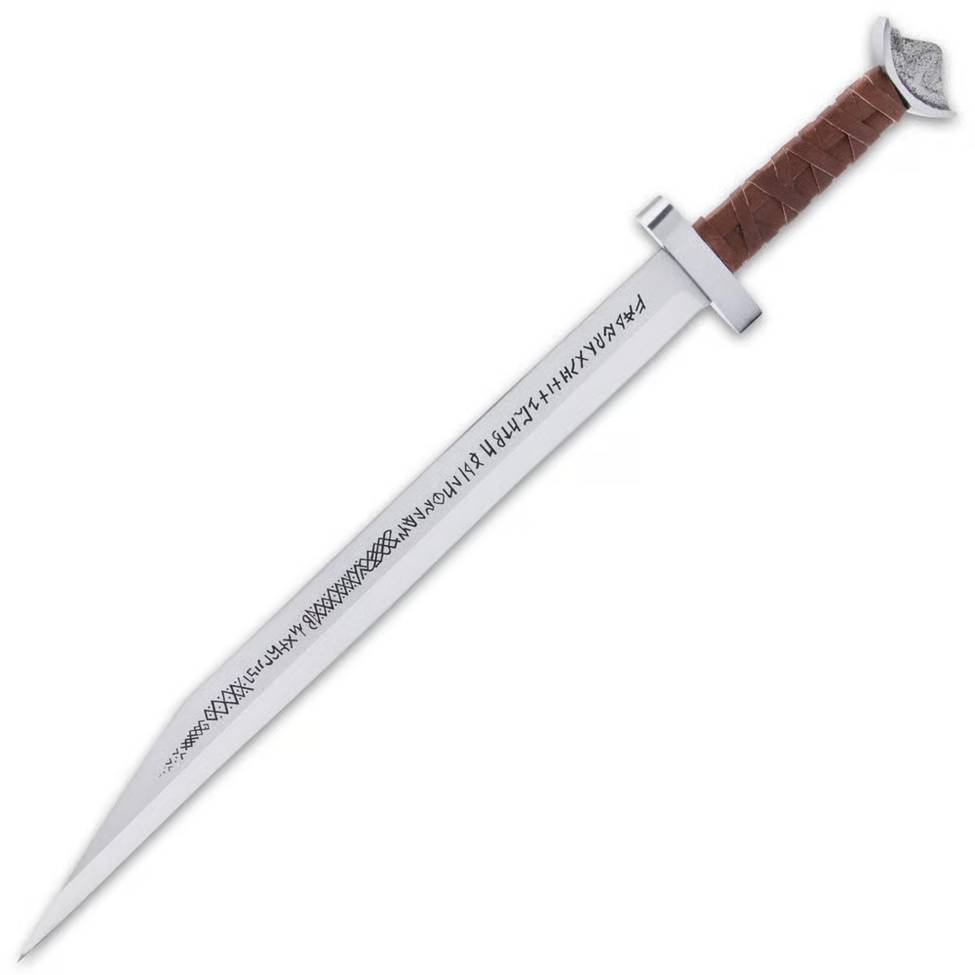
Among the wide variety of Viking and Anglo-Saxon weapons, the seax sword holds a unique place. Unlike the long, double-edged swords that dominate popular imagination, the seax was a single-edged blade, often shorter, and widely carried across northern Europe during the early medieval period. It was both a weapon and a tool, practical in daily life and deadly in combat. But not all swords of this type were created equal. Some were simple, utilitarian blades, while others carried ornamentation and inscriptions that elevated them into the realm of status symbols. Among these, the Seax of Beagnoth—now housed in the British Museum—stands out as one of the most intriguing and valuable examples of early medieval weaponry. For sword enthusiasts and historians alike, it represents a fascinating blend of craftsmanship, cultural symbolism, and mystery.
A Blade with a Name
Discovered in the Thames in 1857 and dated to the 10th century, this sword is an Anglo-Saxon weapon of considerable size. Its blade measures around 55 centimeters, large enough to be a serious fighting weapon, but still distinct from the longer swords of the era. What makes it especially significant, however, is the inscription running along the blade. One side features the name “Beagnoth,” an Anglo-Saxon personal name linked to the Kentish region. This identifies either the owner, the maker, or perhaps someone associated with the blade’s commission. The mere presence of a name elevates the artifact, transforming it from an anonymous piece of iron into a personalized object tied to a historical individual. For enthusiasts, this human connection is invaluable: it gives the weapon identity and context.
Inscriptions and Alphabets
Even more intriguing is the other inscription: a version of the runic alphabet, the so-called futhorc. Strikingly, the sequence is laid out almost as if it were an instructional primer, with letters running in order but with mistakes toward the end. This choice is puzzling. Was it meant as a magical charm, where the presence of the runes themselves conveyed power regardless of order? Or was it intended to signify literacy and learning, prized skills in a society where knowledge of writing carried prestige? The ambiguity of this inscription makes the Seax of Beagnoth both unusual and endlessly debatable, a key reason why collectors and historians value it so highly.
Extraordinary Decoration
This particular seax is covered in wire inlay, using silver, copper, and what appears to be brass. This technique, known as niello or damascening in broader contexts, required skill and painstaking labor. Grooves had to be carved into the steel, wires prepared and twisted, and then carefully hammered into place. What puzzles experts is the seemingly haphazard way the decoration was executed. Some geometric patterns show a degree of consistency, but many do not. Chevron patterns point in different directions, wires of different metals are mixed randomly within single letters, and the overall effect lacks the coherence one might expect from such an elite weapon. Another is that the randomness itself carried meaning; perhaps reflecting ideas of variety, magic, or coded symbolism now lost to us. Either way, this peculiarity makes the seax even more captivating: it resists easy explanation.
A High-Status Weapon
Despite its quirks, there is no doubt that the Seax of Beagnoth was a high-status object. Ordinary swords of the type were plain tools; this one was elaborately decorated with precious metals, personalized with a name, and inscribed with runes. Its size, too, sets it apart: at 55 centimeters, it was clearly meant for combat, not just utility. For Viking and Anglo-Saxon warriors, weapons were more than instruments of war; they were extensions of personal identity, markers of wealth, and carriers of symbolic weight. A seax sword like this was as much a statement piece as it was a weapon.
Why Enthusiasts Value It
Sword enthusiasts and historians value the Seax of Beagnoth for several reasons. First, it is rare, one of the few seax swords that survive with such extensive decoration and legible inscriptions. Most weapons of the time were lost, destroyed, or corroded beyond recognition. Second, it challenges assumptions. Rather than presenting a neat, orderly piece of craftsmanship, it displays oddities: the runic alphabet primer, the inconsistent inlay, the possible errors. It forces us to question what we think we know about early medieval artisanship and symbolism. The Seax of Beagnoth is also valuable because it connects directly to the people of its time. The name Beagnoth makes the weapon personal, and the inscriptions suggest layers of meaning—whether magical, educational, or social—that scholars continue to debate. For enthusiasts, this sense of connection to the human past is priceless. The blade is not just a piece of steel but a window into the mind of its maker and owner, however enigmatic.
True Swords Offers a Seax of Your Own
True Swords offers seax swords that replicate all the qualities of this piece, one of the most extraordinary swords found in history. Its qualities and the mystery behind its making, make it such a valuable artifact. While the Seax of Beagnoth does not give up all its secrets easily, you can get one from True Swords collection of Viking and seax swords, You can wield one of the most valuable and mysterious weapons in history.